Category

Skeleton article title placeholder text spanning two or three lines while the content loads from the CMS


One of the main source of the recruits for Russian regime, waging the terrorist war in Ukraine and Europe — teenagers.
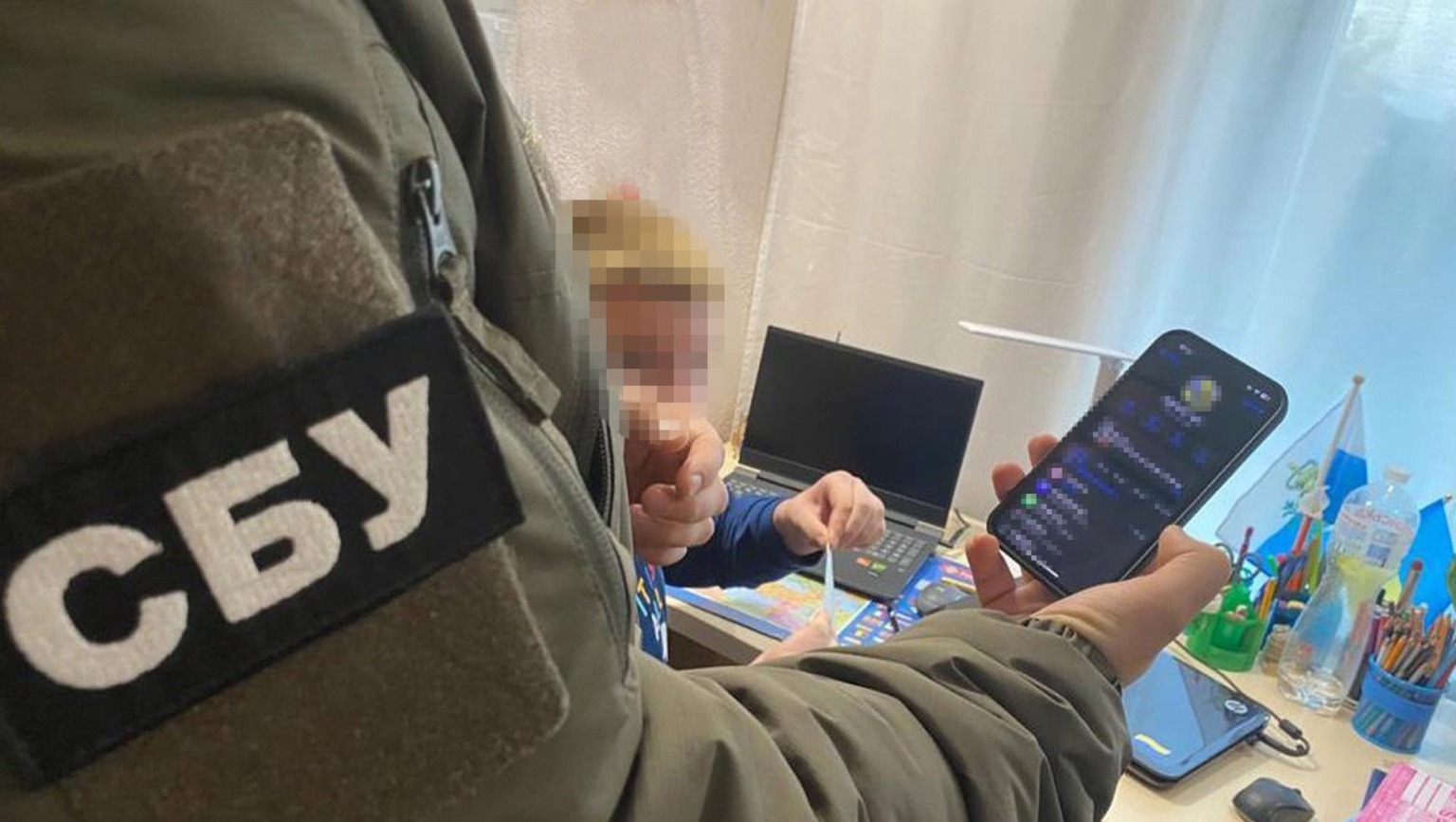
One of the main source of the recruits for Russian regime, waging the terrorist war in Ukraine and Europe — teenagers.
How, by what means and ways these teens are being drafted into terrorism? Who out of them are the most leaning and vulnerable to this? How to protect your children and the country?
These are the questions and answers to them in the newest analysis of the Centre of Strategic Communications of Ukraine.
Here's the analysis in full.
Russian intelligence services systematically target Ukrainian citizens for recruitment. Enemy intelligence shows particular interest in teenagers, exploiting age-specific vulnerabilities. According to the Security Service of Ukraine (SBU), in 2024–2026 alone, Russia drew 327 minors into sabotage and terrorist activity in Ukraine. At least 41 such cases were publicly communicated in detail by Ukrainian law enforcement. Sabotage activity is a component of the war. Involving children in it constitutes a war crime and a gross violation of international law.
The Centre for Strategic Communications explains the mechanisms Russian intelligence services use to recruit teenagers.
Recruiters look for teenagers where they spend the most time: social media, messengers, gaming chats, dating apps, and similar platforms. An analysis of publicly communicated cases from 2023 to 2026 shows that the Telegram messenger is used most frequently — it was the channel recorded in 30 out of 41 recruitment cases.
The primary hook for teenagers is easy money: a promise of quick earnings featured in 32 cases. Children are offered anywhere from a few hundred to tens of thousands of hryvnias to complete specific tasks — putting up leaflets, photographing a military facility, or carrying out an arson.
Handlers often conceal the true origin of the tasks, or promise substantial sums only to block the teenager or pay out next to nothing after the job is done. In one case, a teenager was promised 5,000 dollars to set fire to a Ukrainian Armed Forces vehicle in Ternopil Oblast — and received nothing. Instead, according to the court verdict, his family was ordered to pay over 230,000 hryvnias in damages.
Tasks may be framed as a "quest." If a teenager tries to stop or refuses, blackmail follows. Intelligence services threaten to hand their correspondence over to law enforcement, intimidate them with physical violence against relatives, or use personal photos and data obtained during prior communication to coerce them into carrying out increasingly complex and dangerous tasks. In one case in Ternopil, a female teenager was forced by her recruiter to plant explosives near a district police station, under threat of leaking her intimate personal photographs.
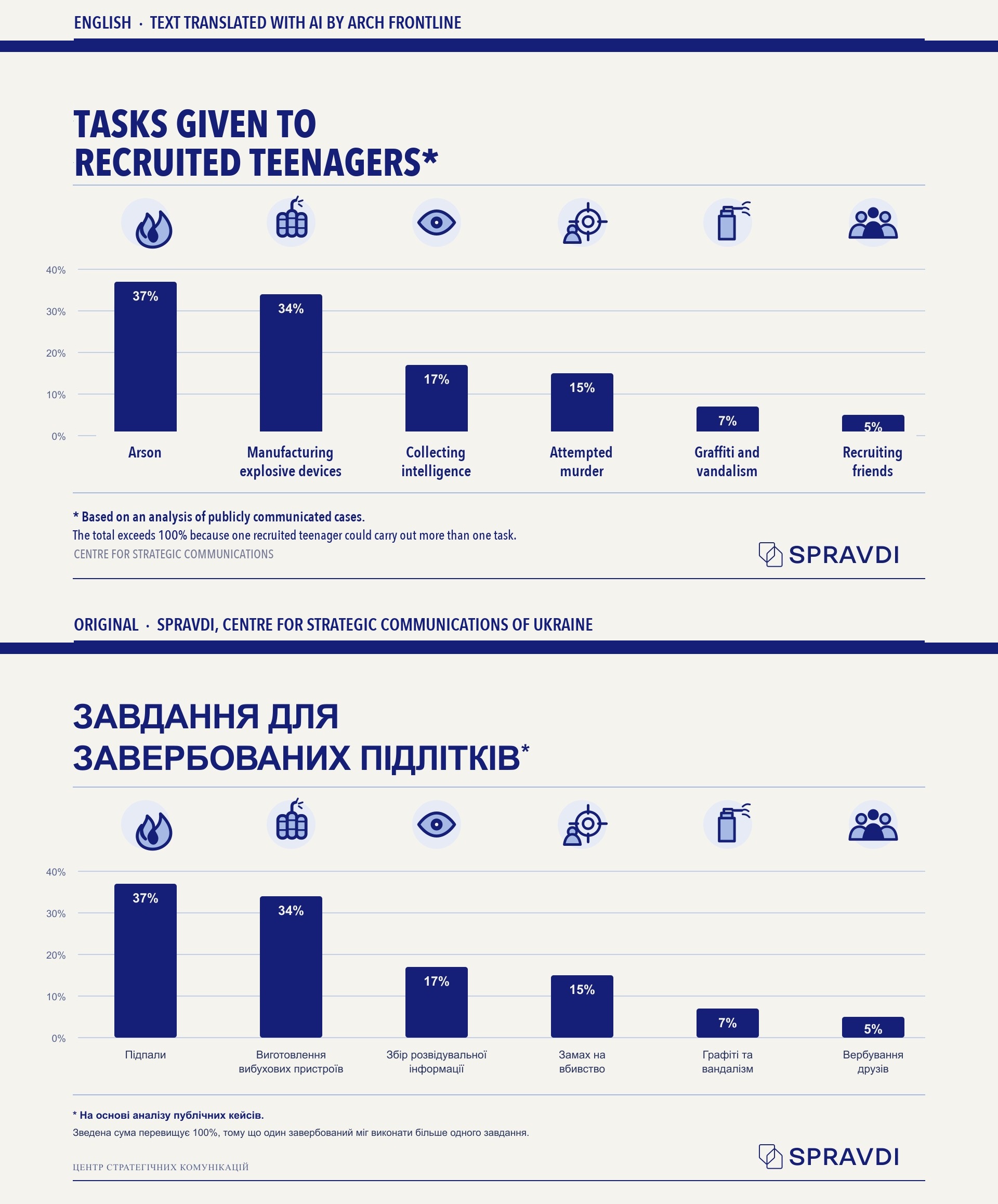
An analysis of communicated cases shows that recruiters typically draw children and teenagers in gradually. Initially, teenagers may be offered a small reward to paint graffiti or commit an act of vandalism. At this stage, handlers assess the child's reliability, then progressively move on to reconnaissance: collecting information and taking photographs. Teenagers film air defense positions or energy infrastructure under the guise of participating in an "urban quest." Over time, the tasks multiply and the danger escalates.
One example of such gradual manipulation is the story of two lyceum students from Odesa, whom a handler operating under the alias "Penguin" found in a Telegram job-search chat. Starting with simple anti-state graffiti for a few hundred hryvnias, he step by step nearly led the boys to commit arson attacks on Ukrzaliznytsia relay cabinets and to attempt to manufacture explosives for a terrorist act. A similar tactic was used against a 17-year-old lyceum student from Kremenchuk. Handlers first made him carry out a "test" car arson, and then ordered him to build two explosive devices and blow up a police station.
There are documented cases of teenagers being pressured into recruiting their own friends or acquaintances into the scheme. In Voznesensk, an older boy drew his eighth-grade acquaintance into arson attacks on Ukrzaliznytsia relay cabinets.
One of the most common types of sabotage is arson — it features in 15 known cases. The primary targets are military personnel's vehicles, electrical substations, and relay cabinets. Another example is the assembly and planting of improvised explosive devices — teenagers were pushed toward this dangerous step in 14 of the cases analyzed by the Centre. Explosives concealed in fire extinguishers or backpacks are ordered to be planted near district police stations, territorial recruitment centre buildings, railway stations, hotels, and other public places.
There are documented instances of targeted assassination attempts against military personnel organized through dating apps, and of planned attacks on schools and lyceums using explosives and weapons.
Not all teenagers fall for the provocations: many refuse the "assignments" and report the recruitment attempt to law enforcement. The SBU's specialized chatbot "Burn the FSB Agent" has already received over 5,000 reports of attempts by Russian intelligence services to recruit citizens. Meanwhile, the Cyber Police and other specialist units regularly acknowledge and commend conscious young people and citizens who resist provocations, preserve evidence of correspondence, and help law enforcement expose enemy networks.
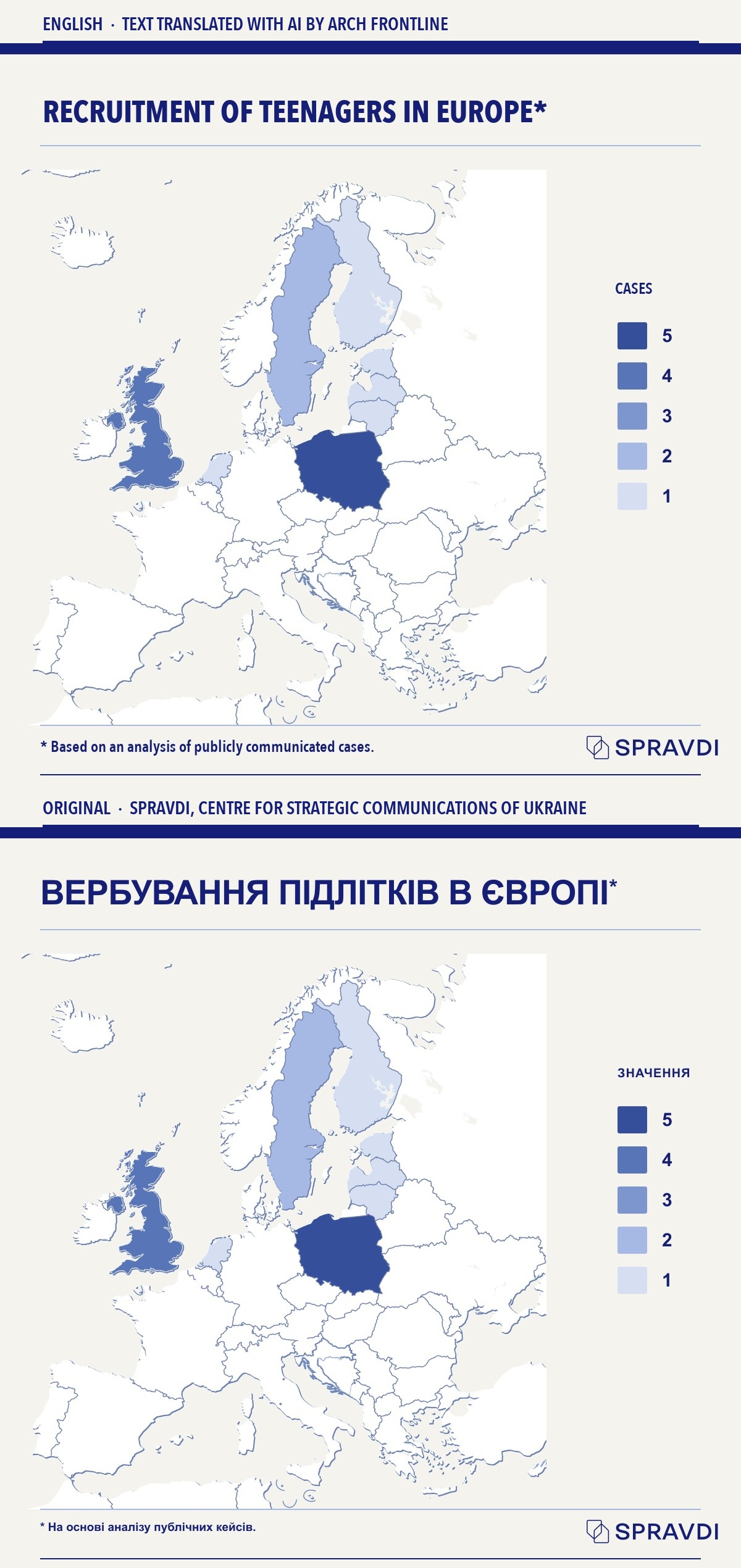
Russian intelligence services operate according to the same playbook against Ukrainian teenagers and against young people in European Union countries alike. The tactics and manipulations tested on Ukrainian minors are now being actively replicated abroad by the Kremlin — in Poland, Lithuania, Latvia, Sweden, the Netherlands, Estonia, Finland, and the United Kingdom.
Law enforcement agencies and intelligence services in these countries have publicly reported at least 16 cases of minors and young people being drawn into acts of sabotage in 2024–2026. In 11 cases, the involvement of Russian intelligence services and associated structures — including the Wagner PMC — has already been officially confirmed. In the remaining cases, there are well-founded suspicions of Russian involvement and investigations are ongoing.
In six of the 16 cases, the subjects recruited were Ukrainian citizens abroad. The exposure of these saboteurs is being exploited by Russia to amplify anti-Ukrainian sentiment — particularly negative attitudes toward refugees — within the EU.
Anonymous Telegram channels advertising "easy side income" are, again, the primary recruitment tool. Russian principals treat young people as convenient and "disposable" material. In response, European counterintelligence agencies and law enforcement are attempting to react firmly — young saboteurs receive real prison sentences or fines amounting to hundreds of thousands of euros.
Moreover, European youth today is becoming increasingly active in the public and political life of their countries, which frequently places them in the crosshairs of external adversaries. For example, mass protests and unrest among teenagers and school students in France and Germany are already causing serious concern. Although official confirmation is not yet available for every case, these events may indicate potential covert interference and destabilization on the part of Russia or Iran. As we can see, Russia employs identical recruitment and influence practices against Ukrainian teenagers and young people in other European countries alike — a pattern that is traceable in these cases as well.
Russian principals treat young people as convenient and "disposable" material.
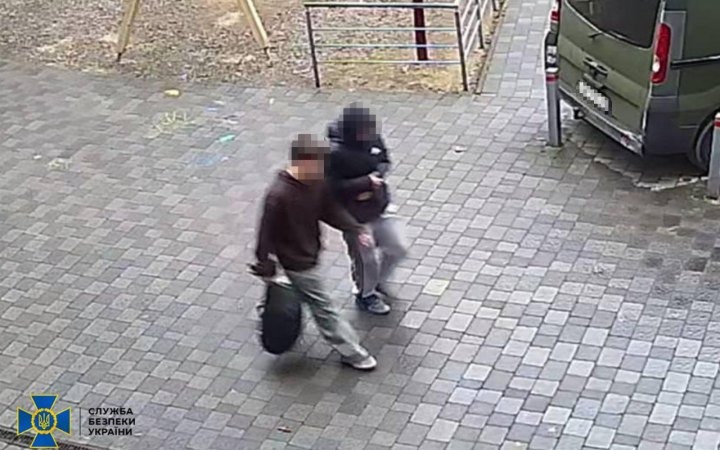
Ukrainian justice responds with equal speed and severity. In the analyzed cases, minors receive notices of suspicion and convictions.
The crimes into which children are drawn are prosecuted under the following articles of the Criminal Code of Ukraine:
The primary weapon against enemy manipulation of children and teenagers remains attention, trust, and awareness. It is important for parents to build open communication with their teenagers, emphasizes the Centre for Strategic Communications' project Dovidka.info.
Parents should be alert to sudden changes in their child's behavior, the appearance of new acquaintances, or unexplained personal funds. It is also important to discuss the reality of criminal liability, since a young age does not protect against severe sentences.
Children should be shown through concrete examples that any offer of "easy earnings" on social media is not a stroke of luck but almost always a trap and a serious risk.
It is important to cultivate media literacy in teenagers — in particular, to explain why anonymous accounts online cannot be trusted and why a few thousand hryvnias are not worth a ruined future or risking one's life.
If recruiters have already made contact with a child, action must be taken immediately and calmly. The first priority is to preserve all evidence: take screenshots of the correspondence and record the accounts, phone numbers, and contacts of the handlers. After that, law enforcement should be contacted at once.
The key message to convey to a child or teenager is this: reporting to the police in time can save them from prison or even death. And if for any reason they are afraid to tell their parents, they should report the approach to law enforcement on their own.