Category

Skeleton article title placeholder text spanning two or three lines while the content loads from the CMS


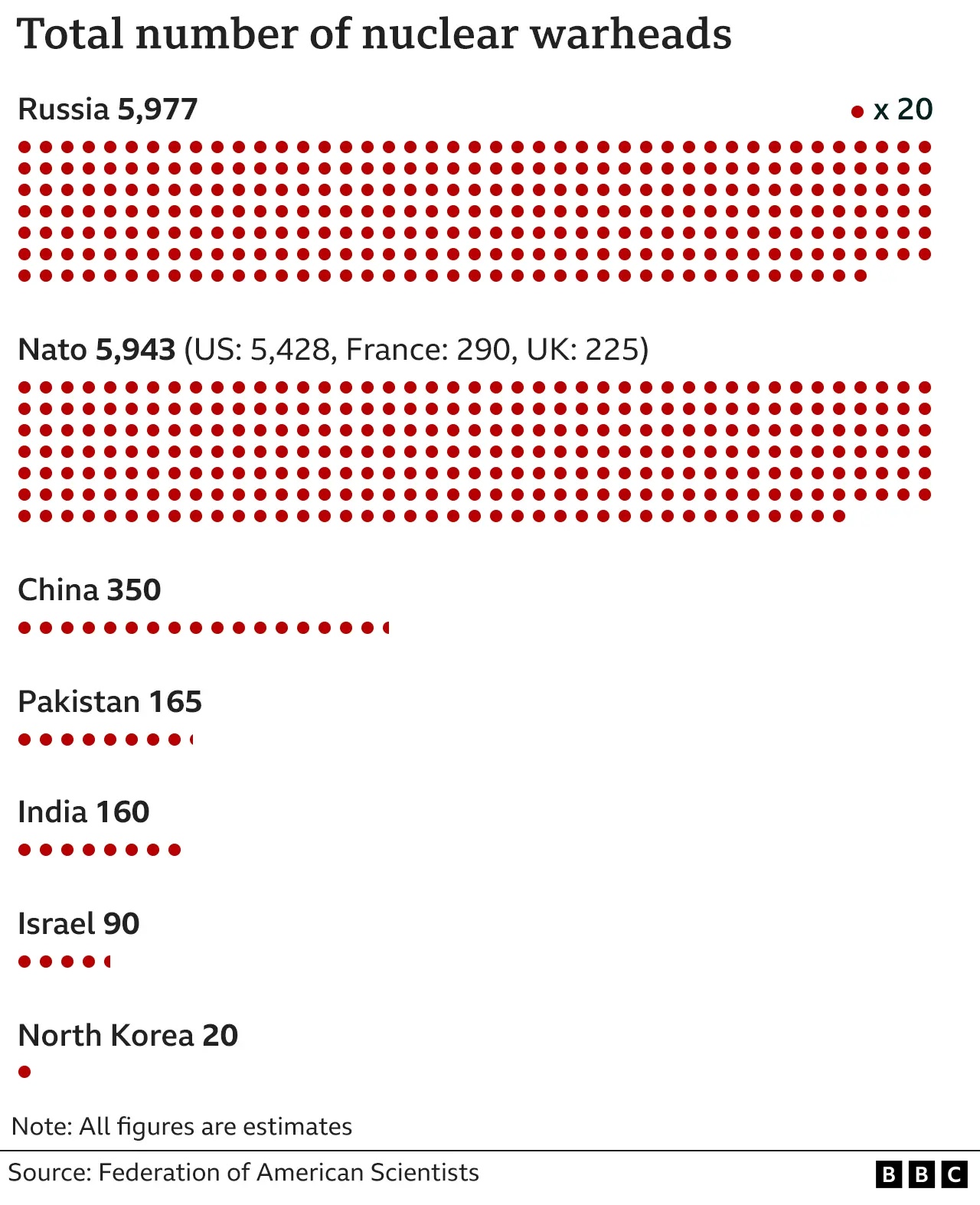
Nuclear weapons and the possibility of using them are an uncomfortable topic in the global political arena. A kind of ambivalence has accompanied this weapon almost from the beginning. After the catastrophic experience of Hiroshima and Nagasaki, nuclear weapons were seen as absolutely the last argument in the war (and weapon, which it would be better not to use). It even created a philosophical conception that this kind of weapon is not for use, but that its mere presence is itself a deterrent (and a guarantee of the security of the state that owns it).
Possible to say that, for a long time during the Cold War, nuclear rhetoric also had certain rules and taboos. For example, both the U.S. and the U.S.S.R., in fact, similarly declared that they would use nuclear weapons only as a response to a nuclear attack. It means that an understanding prevailed that nuclear weapons can be used only as a last argument in a situation where the other side begins a nuclear war. At the same time, both sides of the Cold War confrontation publicly declared many times that they did not have a plan to use this kind of mass destruction weapon first, and accused the other side of the possible escalation.
All these things did not mean that nuclear war is impossible. We can remember the Caribbean crisis, when the U.S. and the U.S.S.R. were one step away from such a confrontation. Fortunately, both sides chose a diplomatic solution to the crisis.
In this context, the phrase "modern Russia is not a U.S.S.R." can have an interesting angle. On the one hand, Moscow, similar to the times of the U.S.S.R. and the Russian Empire, did not lose its imperial dreams. The war against Ukraine proves it perfectly. On the other hand, in nuclear rhetoric, Russia took a step forward (or, better to say, to the side) compared to the Soviet Union.
Vladimir Putin did not hesitate to publicly discuss the possibility of using nuclear weapons "to protect the interests of Russia". This topic is not taboo in Russian state-controlled media, either (but has some nuances, which will be shown further). Also, nowadays, the usage of nuclear weapons is presented not only in the context of a possible confrontation with another nuclear state. Moscow began talking about nuclear weapons as an argument (and a solution) in its own war of aggression against Ukraine.
All these aspects raise a question: what does the change in Russian rhetoric about nuclear weapons mean, what messages and signals (and why) the Kremlin tries to send to the World, and how the Western World can react to it in the best way? This article attempts to answer at least some of these questions.
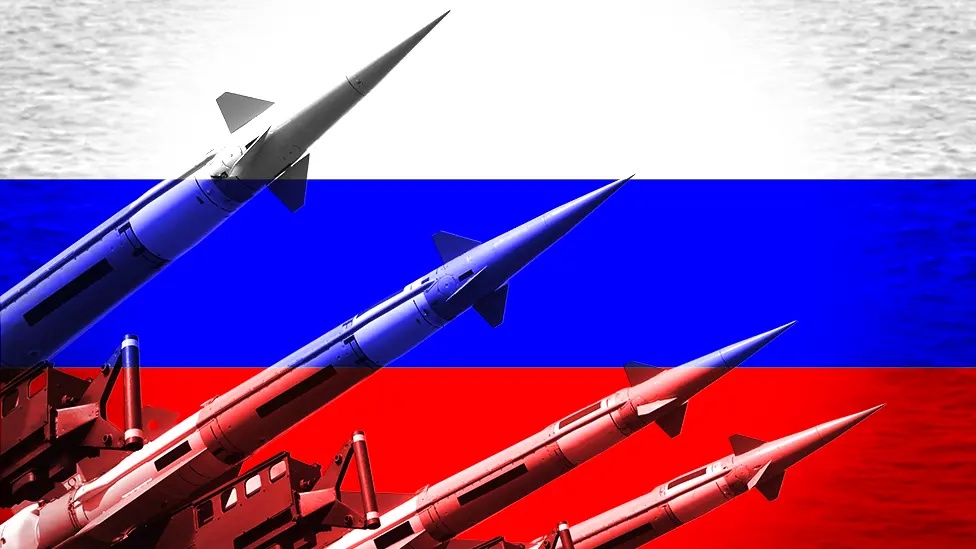
From the beginning of the conventional war against Ukraine in 2022, Moscow has tried to remind everyone that Russia is a nuclear power. During the first weeks of the so-called "special military operation" (Russia still does not want to call it a war against Ukraine), it was very important for the Kremlin to ensure that the Western World would not interfere.
The earlier stages of Russian nuclear rhetoric in the war against Ukraine are explored in the working paper by Liviu Horovitz and Martha Stolze. From this work, it is evident that Moscow started communicating hints about the possible use of a nuclear weapon after the first three to four days of the invasion. It is time when it becomes visible that aggression against Ukraine is not going according to the Russian scenario. That Russian "blitzkrieg" failed to become obvious for the Western World, too. At that time, Moscow feared that Western support for Ukraine could intensify, including direct military action (for example, Kyiv asked Western countries to close the sky over Ukraine, but the Western World remained deaf to this call). Russia began to talk about Western support of Ukraine as a "very real threat" to "the very existence" of Russia. Understandably, such a threat can be a pretext to use a nuclear weapon for "defence."
Russia became especially active with nuclear threats in the fall of 2022. The rhetoric was directly connected to the Russian Federation's "territorial integrity." At that time, Moscow declared several Ukrainian territories part of Russia. Paradoxically, not all of these territories were fully controlled by Moscow. At the same time, Russia in fact declared that any attempts to defend Ukraine's controlled parts of these territories or liberate territories occupied by Russia will be evaluated as a violation of the territorial integrity of Russia. Formally, it is also the pretext to use a nuclear weapon.
In the context of the first year of the Russian war of aggression against Ukraine and nuclear threats, the case of the Zaporizhzhia nuclear power plant should be mentioned. This is Europe's largest power plant, which was seized by the Russian army. At the same time, Moscow began to accuse Ukraine of preparing some terrorist activities against the plant, to create a nuclear catastrophe. All these statements raise suspicions that Moscow has some plans for nuclear provocations of its own.
The Western World reacted to Russian threats carefully. The important thing is that Moscow also got some clear warnings that the use of nuclear weapons would have some consequences. For example, in October 2022, the U.S., the U.K., and France warned Moscow that they would retaliate with conventional weapons in the event of the use of nuclear weapons in the war against Ukraine.
The decision of Russia to deploy nuclear strategic weapons on the territory of Belarus should be interpreted as an act of strategic communication, and not pure military action. This decision was made in 2023. By this step, Moscow put nuclear capabilities closer to the territory of the Western World. It is possible to totally agree with the evaluation that "the publicity given to the [this] decision by Moscow and Minsk is part of a psychological operation calculated to make the West yield to nuclear blackmail and reduce its support for Ukraine."
Even more than four years after Russia began a conventional war against Ukraine, nuclear rhetoric has not weakened. Moscow still uses it from time to time. For example, in May 2026, Russia held a suddenly announced exercise of nuclear forces. In the context of the exercises, Moscow also published a transcript of a conversation between President Vladimir Putin and the Commander of the Strategic Missile Forces, Sergei Karakayev. It was done for strategic communication purposes. In this conversation, Putin underlined Russia's nuclear capabilities and called the Russian Sarmat system "the most powerful missile system in the world." It was quite obvious that this information was framed not for Karakayev but for a broader audience.
Finally, a new case of Russian nuclear threats is linked to the Kaliningrad district, the Russian anclave encircled by the territory of the EU and NATO. Moscow rhetoric was used to respond to a hypothetical scenario of the isolation of the district mentioned above. Officially, Russia reacted this way to what it defines as "the provocative statements and actions of the North Atlantic Alliance's leadership and NATO member states." The potential nuclear threat can be seen in this part of the message published by the Russian embassy in Belgium: "We have emphasised that Russia possesses the necessary means to repel any potential aggression and is prepared to deploy its entire arsenal to defend its territory should NATO countries attempt to isolate the Kaliningrad region from the rest of our country." Later, a similar warning was repeated by Russian President Putin during his speech at the Valdai Forum.
It should be noted that the question of "isolation of Kaliningrad" can be topical in a situation if Russian aggression against Ukraine widens and includes a direct (or indirect, in some cases) confrontation with NATO. It seems that Moscow has this hypothetical scenario on its agenda.
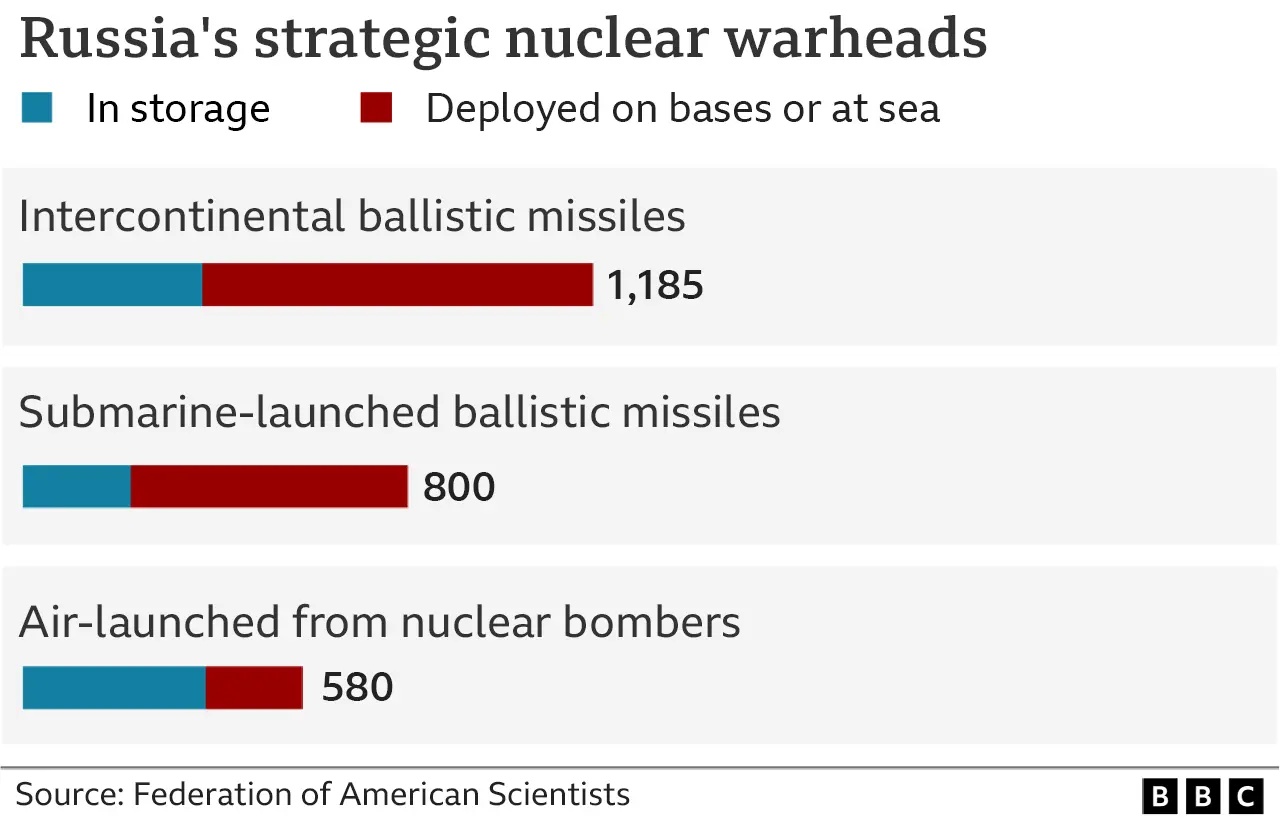
The narratives about the possible use of nuclear weapons in Kremlin propaganda for the inner audience and the audience outside of Russia are not presented equally. It is noticeable that threatening to use a nuclear weapon is not so popular in messages for the audience inside Russia. For example, it presented a comparative analysis of publications by the Russian information agency RIA Novosti (for the Russian domestic audience) and RT (for the foreign audience). One of the conclusions of this study is that "domestic and foreign state media in Russia also portrayed the potential risks of the war differently, as RT gave much more attention to nuclear weapons and Russian nuclear threats compared with RIA Novosti."
Such a conclusion is explainable. Russian state propaganda uses different tactics and goals when presenting the topic of the war against Ukraine to domestic and foreign audiences. In coverage for the domestic audience, the purpose is to present war as inevitable but routine. The main message is that Russia is winning and will win anyway. But the escalation of nuclear rhetoric is destroying this narrative. If you need a nuclear weapon as an argument, it means that you are pushed to the corner, and on the table is not a question of victory but merely a question of the survival of the state. This is a message the Kremlin does not want to convey to audiences inside Russia.
It also shows analysis of reactions in Russian state media to the article of one of the Russian public sphere's "hawks," Sergey Karaganov. In 2023, he, in his text, published on the platform Profile.ru, offered to make a series of nuclear strikes on targets in some Western countries. In his opinion, this would "sober" the West and force it to "retreat or even capitulate." The interesting fact is that this offer was largely unsupported by other media propaganda. In general, opinions were opposite to Karaganov's position. Mostly, they stressed that Russia can achieve its goals using traditional weapons. The unpredictability of such a confrontation was mentioned, too.
For the Kremlin, it is important to ensure domestic audiences feel stable. Karaganov's idea was not supported, because even the biggest fans of Putin understood that nuclear weapons are a last argument and their use can have serious consequences. The result of escalation, involving the West directly, can not be predicted.
On the other hand, the Kremlin likes to threaten foreign audiences with the possibility of a nuclear war. Russia bases its propaganda messages on the statement that the Western World is intervening in the local conflict between Russia and Ukraine, and that it is the West that is escalating the situation and forcing Russia to "defend itself." In other words, the main idea is that if Moscow uses a nuclear weapon, it will be the West's fault. By this logic, the termination of support for Ukraine is de-escalation, when continuing the support means a growing possibility of "nuclear war."
Nuclear threats are cultivating the big fear that can affect decisions at a high level.
Kremlin sees a "nuclear card" as a powerful "bargaining chip" in the modern geopolitical game, and it is not possible to say that this vision is false. Nuclear threats are cultivating the big fear that can affect decisions at a high level.
On the other hand, Moscow is currently waving this card, showing it has it but not putting it on the table. Does it mean that Russia will never use it? Here, it's not so easy to say "yes" or "no." The Kremlin can keep it till the end of the game, for the last move (if necessary), in the hope of winning. The rhetoric, in which a nuclear strike is possible and appropriate, helps Moscow to embrace this idea.
The risk is growing in a situation where the Kremlin believes that this would be a last, winning move. It means that the strategy for the Western World should ensure that Moscow understands that the consequences of using nuclear weapons will be inevitable.
The level of consequences for Russia should be a subject of discussion (and first, between nuclear powers - the U.K., France, and the U.S.). Anyway, necessary to keep in mind that the principle of deterrence is that the aggressor should potentially pay a price that exceeds the benefit. So, the consequences for Moscow should not be theoretical or symbolic. This message needs to be presented not only to the Kremlin but, ideally, to Russian society as well. Of course, it is not so easy. The Western World is facing a fear of escalation and several taboos that no longer exist for Moscow. But for effective strategic communication that can prevent a real crisis, strong messages are essential (as are inner strength and resolve). The Kremlin should be forced back to Fyodor Dostoevsky's idea about crime and punishment, and, without a doubt, the use of a nuclear weapon in a war of aggression is a really big crime.