Category

Skeleton article title placeholder text spanning two or three lines while the content loads from the CMS


Ukraine needs European Union (EU) to become the new state and real republic, but EU also needs Ukraine to become real geopolitical subject and global power. That is — to survive.
Previously in this series: Part I: the frontier condition, the ration of trust and the next republic
Ukraine needs European Union (EU) to become the new state and real republic, but EU also needs Ukraine to become real geopolitical subject and global power. That is — to survive.
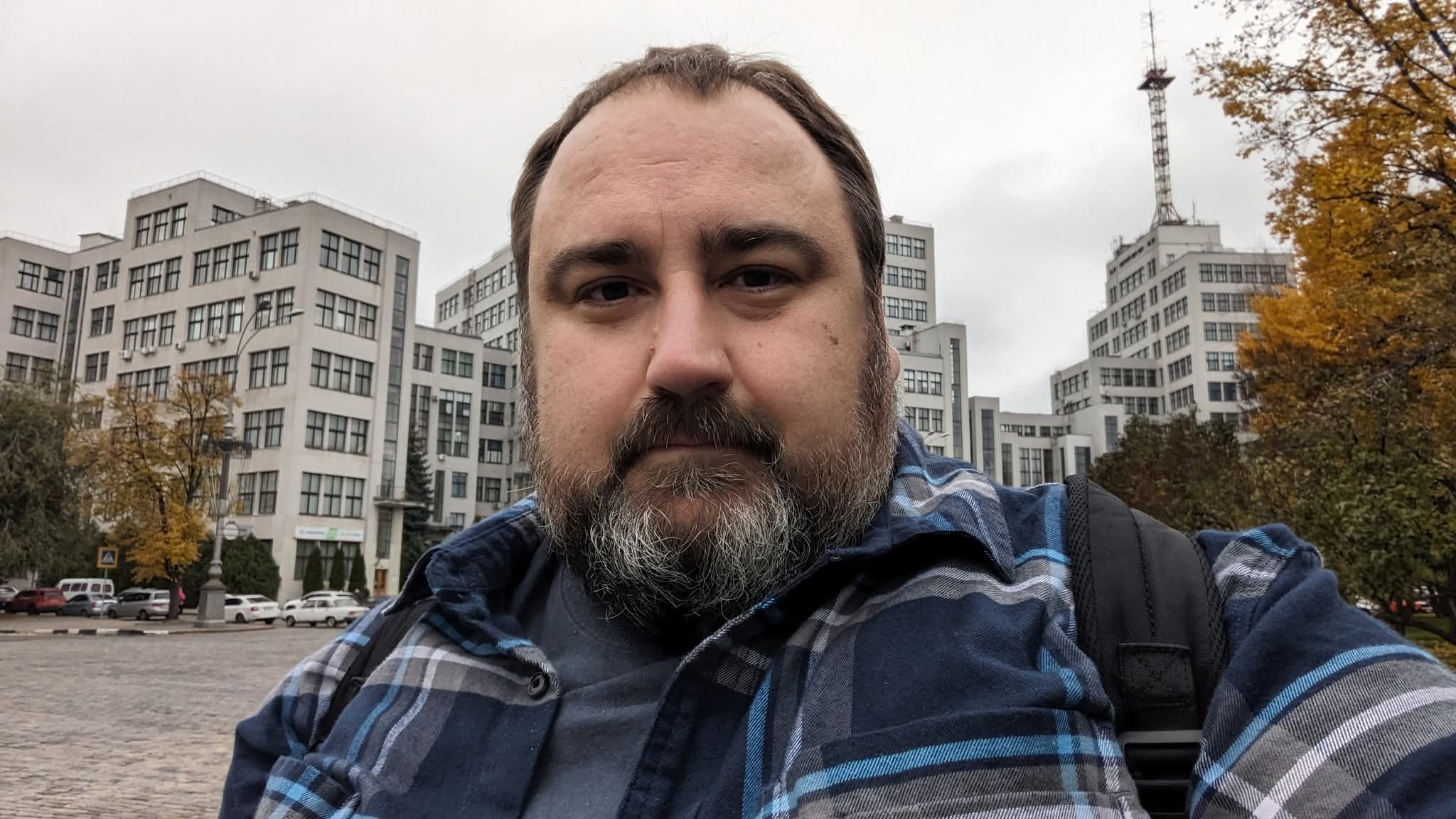
That was one of the main takes of Yevhen Hlibovitsky, prominent Ukrainian intellectual, journalist, civil rights figure, expert of strategic consultancy in conversation with "Arch Frontline".
Head of the Frontier Institute was named one of the 30 most influential public voices of the country by major Ukrainian media outlet "Ukrainska Pravda".
"When we look at how the world sees this war ending, it wants to see it stopped, not evil named as evil and punished accordingly. From that, we can see that the slogan "never again" is empty, and that the lessons of the Second World War were never institutionally internalized.
If we keep moving along this inertial trajectory, we're laying the groundwork for a new cold war between the developed world and a new totalitarian bloc of the future" — says Mr. Hlibovitsky.
Europe has to become a geopolitical union, because continuing as a union of prosperity is no longer a sufficient premise. Prosperity is a necessary, but not sufficient condition. The shift to a geopolitical union means changes to sovereignty, changes to policy: essentially across all spheres of life, from education, cognitive space, and culture to public spending and administrative priorities. That's a gigantic shift.
EU integration is critically important for Ukraine, just as I'm convinced the European project isn't possible without Ukraine. That impossibility of the European project without Ukraine is understood very differently within the EU. Ukraine's aspiration to integrate into the EU is, in a sense, an aspiration to integrate into a particular dream of the European Union, one that, as recent years have shown, doesn't always materialize: alongside a sense that collective security remains out of reach, that even a synchronized understanding of the values written into Article 2 of the Lisbon Treaty is out of reach, a sense that Europe exists across radically different time horizons and orientations, where, in most of Europe, nostalgia for the past outweighs any vision of the future, while in part of Europe it's the reverse: a motivator for internal change and self-improvement.
If Europe can't resolve these crises, it won't be able to act as a player. The long-running success of the European project has lulled many Europeans into thinking that Europe's success is a given. It is not a given, any more than the success of the ancient world, which collapsed under pressure from the "barbarians," was a given, or the success of the Aztec or Maya societies was a given.
What we're really talking about is that Ukraine shouldn't be the occasion for integrating it into Europe on the old terms, but the occasion for forming a new union on entirely new terms. Those new terms require changing the very nature of the European Union: if we don't become a union capable of defending itself, the capacity of small and mid-sized powers to draw dividends from banding together into the quasi-great power that is a united Europe will effectively collapse.
Prosperity is a necessary, but not sufficient condition.
The Baltic states, in my view, are a very important reservoir of sobriety within the European Union, and I very much hope that with Ukraine's accession, Ukraine's weight will strengthen the Baltic vector of development and the importance of a distinctly Baltic worldview. From what we currently see, Ukraine's closest partner grouping is NB8 (the Nordic-Baltic Eight), and in my view, this group's lens sees the transformation of the European Union, and the possible new conditions for a paradigm shift within NATO, far more soberly than any other grouping or configuration in Europe, whether that's Central Europe, "old" Europe, Mediterranean Europe, or any other configuration.
I think the Baltic states' qualitative contribution is, first of all, undervalued and underappreciated, and the Baltic states are very often perceived as a single bloc, when in fact they're three very different voices with different lenses and different approaches.
But I think what they share is that they've long gotten used to a certain degree of being overlooked, and just how difficult the current term of EU Commissioner Kallas has been, particularly in her dealings with the large member states, shows how hard it is for the traditional establishment to accept the Baltic logic and the Baltic paradigm, in which there's a very responsible treatment of priorities and a very serious role given to security and understanding of threats.
A large part of continental Europe treats security as a given, treats the EU's competitiveness as a given. All of those "givens" can dissolve very easily, with new technological revolutions (artificial intelligence), with cultural shifts (post-postmodernism), with demographic changes that, as we can see, are happening in the EU irreversibly. There's a very real chance that Europe could sleep through the critical moment of its own existence, and the Baltics, in that sense, are a terribly important alarm clock, a reminder of the agenda. And that's what makes all of us, meaning the Baltics and Ukraine, interested in making the Baltic voice carry more weight.
We won't avoid this demographic catastrophe. It already has to be accepted, and we need to understand what we do with it from here.
The first thing that needs to happen: every strategic decision, every major decision, needs to be made with an understanding of how it affects demographics. That's not the case right now, and as a result, while chasing various tactical goals, Ukraine often takes steps that deepen the demographic catastrophe.
Beyond that, we most likely need to factor in Europe's experience with the tensions and crises tied to migration and integration, and work out how to build the next generation of migration policy, an approach that sees more of the depth of these processes.
When it comes to immigration policy for Ukraine, what will be needed isn't a workforce, but citizens: people ready to take on the full weight of the burdens that will come with it. That means we can't afford to let in people who are moving from one society to another because they'd like to behave less responsibly there; that kind of policy is irresponsible.
Right now, within Ukraine, there isn't a proper dialogue on this topic beyond small interested circles; and when it comes to state policy, it's still at a very early stage.
It means understanding not just business itself, but how business exists alongside other spheres that matter for a good quality of life for society: security, the shared public sphere, culture, education, the environment. Business in Ukraine has more room to exert influence than business in other states does. That's a consequence of how Ukraine's system of governance is structured: the role of the state is muted, while the role of civil society, of business, of the church, and so on, is elevated, and their leadership shapes everything around it.
It's very important that this leadership be well-informed and not confined purely to its own self-interest. Right now we're seeing competition between different types of leadership within Ukrainian business, where the best and the worst examples sit right next to each other.
Here we enter a cone of possibilities that will be very heavily shaped by exactly how the war ends. Whether it ends in a Russian defeat is itself something the entire developed world is working against: across most of the developed world there's a consensus that Russia cannot be allowed to suffer defeat, and that consensus creates the preconditions for Russia to remain a threat and to potentially become aggressive again after some time.
At the same time, there's also a consensus that it would be good if Ukraine achieved something, but that "something" is undefined. As a result, we end up in a situation where the West is fueling the continuation and deepening of the security crisis instead of resolving it.
That leads to a situation where Ukraine, fighting alone, has to guarantee security for an entire continent, and under those circumstances, postwar reconstruction becomes effectively impossible. It will mean further militarization and preparation for the next war, rather than investment, rather than the development of human capital, rather than the things that constitute the key elements of development in the 21st century.
When we look at how the world sees this war ending, it wants to see it stopped, not evil named as evil and punished accordingly. From that, we can see that the slogan "never again" is empty, and that the lessons of the Second World War were never institutionally internalized. If we keep moving along this inertial trajectory, we're laying the groundwork for a new cold war between the developed world and a new totalitarian bloc of the future.
That means the 21st century becomes a century of major confrontation, where a huge share of human development and human talent gets concentrated not on improving our lives, but on how to gain the upper hand over one another, or to subordinate each other. And, unfortunately, given the level of technological development we have and the ethical safeguards we do or don't have, the odds that humanity suffers a collective defeat in such a confrontation are very high.

I think the West still doesn't understand the nature of Ukrainian subjecthood, and I'd go further and say the West doesn't even demonstrate an awareness that it exists. And without that, neither full integration is possible, nor the conditions for a genuine partnership that would finally allow the move from the level of object to the level of partner, and from partner to ally.
I'm afraid the current conditions are formative for future resentments. And resentment is the worst poison that exists in political life: it can lie dormant for decades, for centuries, and wake up unexpectedly under the pressure of some trigger. It's very hard to purge once it's there. Resentments are, in fact, a very powerful mobilizing force for a society: we see that with Hungary, we see it with Poland, we see it in other societies.
In practice, that means we'd be better off not walking into that discourse, not building triggers for Ukrainian society's future.