Category

Skeleton article title placeholder text spanning two or three lines while the content loads from the CMS


This creates a potential contradiction. Washington may be winning cooperation from governments while losing influence among populations.

The Trump administration is seeking to reassert U.S. influence across the Western Hemisphere through a more transactional combination of migration enforcement, security cooperation, economic pressure, and strategic engagement. Yet one of its most consequential domestic policies could undermine the political capital required to sustain that influence.
The termination of Temporary Protected Status (TPS) for roughly 350,000 Haitians, expanding deportations, and the growing use of third-country removal arrangements represent a significantly more aggressive approach to immigration enforcement. Washington argues that these measures restore the credibility of U.S. immigration law and strengthen control over the border. That argument carries genuine domestic political weight.
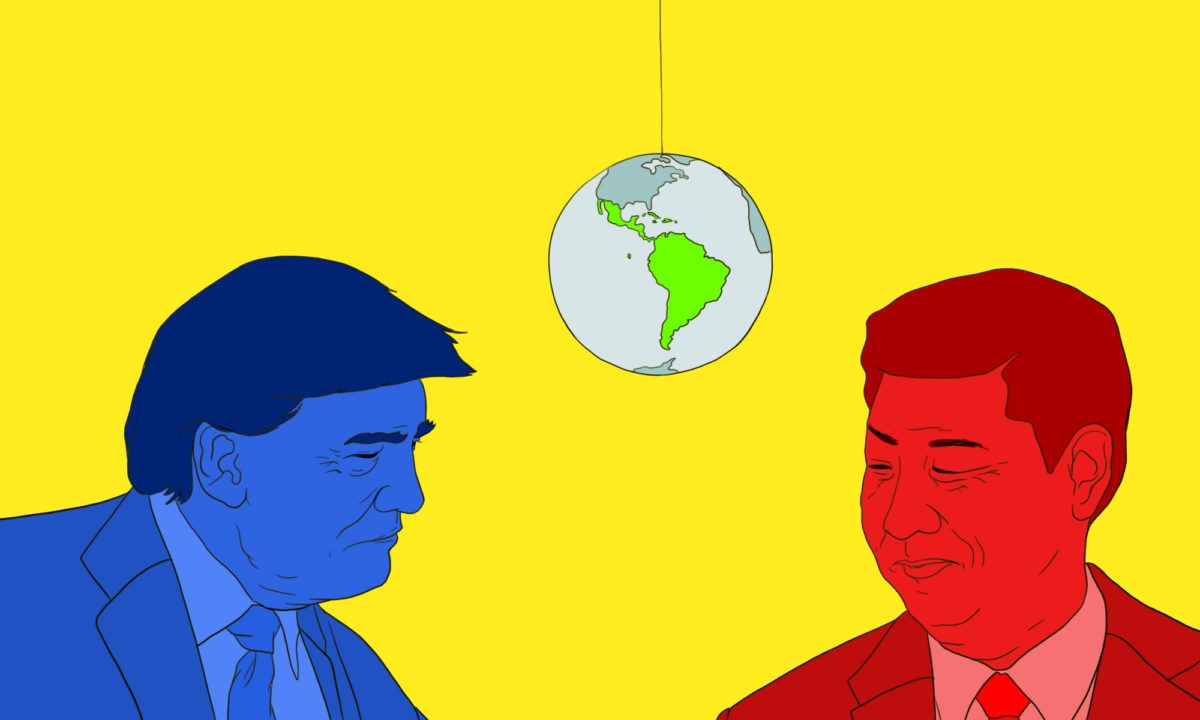
The strategic question, however, is broader. The United States is asking Latin American governments to cooperate with Washington on migration, security, energy, China, and regional stability at the same time that U.S. immigration policy is becoming one of the most visible ways in which those societies experience American power.
This creates a potential contradiction. Washington may be winning cooperation from governments while losing influence among populations.
The issue is particularly important after the 2024 election, when Donald Trump substantially improved his performance among Latino voters. That realignment was politically significant, but it may not be permanent. With Latino voters concentrated in an increasing number of competitive congressional districts, the 2026 midterms will offer an early test of whether Trump's immigration strategy can coexist with sustained Hispanic support.
Venezuela illustrates a related shift in U.S. strategy. Washington has prioritized stabilization, energy access, and strategic control while working with an interim government led by Delcy Rodríguez rather than placing the democratic opposition associated with María Corina Machado at the center of the transition. The emerging pattern suggests that strategic and economic interests can take precedence over traditional democratic conditionality.
None of this means the United States should abandon immigration enforcement. It means Washington needs to recognize that enforcement, domestic legitimacy, and hemispheric strategy are increasingly connected.
Haiti provides the clearest example of the tension.
The Trump administration moved to terminate TPS protections for roughly 350,000 Haitians, and the termination took effect in July 2026 after the Supreme Court allowed the administration to proceed.
The administration's legal and policy argument is straightforward: TPS was designed as temporary humanitarian protection, not as a permanent immigration status. Washington maintains that continuing such protections indefinitely undermines the distinction between temporary relief and lawful permanent residence.
That argument should not be dismissed. The United States has a sovereign right to determine who may remain in the country and under what legal status. Border enforcement is also a legitimate national-security objective, and many Latino voters themselves support stronger immigration enforcement.
But Haiti presents an unusually difficult foreign-policy context.
The country remains one of the most dangerous in the hemisphere. The U.S. State Department continues to advise against travel to Haiti because of crime, kidnapping, terrorism, civil unrest, and severely limited law-enforcement and health-care capacity. Gang violence has displaced large numbers of people and continues to undermine the authority of the Haitian state.
That does not, by itself, determine U.S. immigration policy. It does, however, change its strategic consequences.
When Washington removes people to a country experiencing severe institutional and security breakdown, the decision is no longer perceived solely as an immigration measure. It becomes part of America's relationship with that country.
That matters because U.S. influence in the hemisphere is not exercised only through governments. It also operates through families, diasporas, trade, investment, remittances, and social networks that connect Latin America and the Caribbean to the United States.
The strategic cost of immigration policy therefore cannot be measured only by the number of people deported.

The administration's approach is also extending beyond conventional deportation.
Washington has increasingly negotiated arrangements under which migrants are removed not to their countries of citizenship but to third countries willing to receive them. Liberia, the Central African Republic, and several other states have become part of this emerging system.
There is a practical rationale for such agreements. Third-country arrangements can give Washington additional options when direct repatriation is difficult or politically contested. They also demonstrate the administration's willingness to use diplomatic leverage to expand the pool of countries prepared to accept deportees.
But the model creates new strategic liabilities.
The farther a person is removed from his or her country of origin, the more complicated the questions of due process, security, detention conditions, and legal responsibility become. Once those arrangements generate controversy, the issue is no longer confined to U.S. immigration policy. It becomes a bilateral and regional diplomatic problem.
This is particularly relevant as Washington asks Latin American governments to cooperate more closely on migration.
Governments may accept U.S. pressure because cooperation brings security or economic benefits. But short-term compliance should not be confused with durable alignment. A government can cooperate with Washington today while becoming more skeptical of American leadership tomorrow.
That distinction is central to any strategy based on hemispheric influence.

The domestic political implications are equally important.
The 2024 election demonstrated that Latino voters could no longer be treated as a reliably Democratic constituency. Trump significantly improved his performance among Hispanic voters compared with 2020, coming close to parity with Kamala Harris nationally.
That shift mattered.
It showed that border security, inflation, crime, and economic concerns could move significant numbers of Latino voters toward Republicans. It also challenged the assumption that demographic change would automatically produce long-term Democratic dominance.
But the 2024 realignment may have been real without being permanent.
By 2026, evidence from competitive congressional districts suggested a more fluid electorate. Twelve of the thirty-seven House districts identified as competitive had Hispanic populations of at least 20 percent, including six in which Hispanics constitute a majority.
This creates a strategic vulnerability for the administration.
The political benefits of aggressive immigration enforcement are relatively straightforward: it demonstrates that the government is willing to enforce the law and responds to voters who believe previous administrations failed to control the border.
The political risks are less predictable.
Undocumented migrants, lawful immigrants, naturalized citizens, and U.S.-born Latino voters are not the same constituency. Many Latino voters support stronger border enforcement and oppose illegal immigration. But they may nevertheless react differently when enforcement becomes increasingly visible in their own communities or affects family members and social networks.
The danger is therefore not that deportation automatically alienates Latino voters.
It is that an enforcement policy directed at unlawful immigration could gradually be perceived as a broader policy toward Latino communities.
If that happens, the political coalition that helped Trump make gains in 2024 could prove considerably less durable than it first appeared.
The midterms will provide an early indication of whether this is happening.
If Republicans retain or expand their support among Latino voters, the administration will have evidence that its emphasis on border enforcement can coexist with broader Hispanic political support.
If Latino voters move sharply away from Republicans, Washington will have to confront a different possibility: that the political benefits of immigration enforcement can be offset when enforcement becomes sufficiently expansive or personal.
The implications extend beyond electoral politics.
A president attempting to establish a new hemispheric strategy needs sustained domestic political support for engagement with Latin America. If immigration policy creates a widening political divide between Washington and Hispanic communities, future administrations may find it harder to maintain ambitious regional policies.
Immigration is therefore not simply a border issue.
It is part of the domestic political foundation of U.S. hemispheric strategy.
The deeper strategic issue is how Washington conceptualizes the hemisphere itself.
The Trump administration increasingly treats migration, narcotics, organized crime, energy, critical infrastructure, China, and regional political influence as interconnected components of U.S. national security.
There is a rational basis for this approach.
China's economic presence in Latin America, its involvement in strategic infrastructure and technology, and the vulnerability of regional supply chains give Washington legitimate reasons to pay greater attention to the hemisphere.
But a security-centered strategy carries a risk: Latin American societies can begin to be viewed primarily as problems to be managed rather than partners whose cooperation must be politically sustainable.
The hemisphere is more than a security perimeter.
It is an economic and social system deeply integrated with the United States.
Migration is one of the principal links in that system.
Washington therefore needs to distinguish between controlling migration flows and managing its relationships with the societies from which those flows originate.
Those are different objectives.
The United States can enforce immigration law while simultaneously expanding legal migration channels, strengthening regional security cooperation, supporting institutional capacity, and creating economic incentives that reduce the pressures driving irregular migration.
Such an approach would not weaken enforcement.
It could make enforcement more sustainable.
The administration's approach to Venezuela illustrates the same transformation from a different direction.
Following Nicolás Maduro's removal, Washington chose to work with an interim government led by Delcy Rodríguez rather than immediately transferring political authority to the democratic opposition associated with María Corina Machado.
The administration has justified this approach through the imperatives of stabilization, reconstruction, security, and economic recovery. Energy has been central to that strategy.
Washington's new relationship with Venezuela's oil sector gives American interests an unusually significant role in the country's future energy production. The administration presents this as part of a broader effort to rebuild Venezuela, stabilize the region, and secure access to its enormous oil reserves.
There is a strategic logic to this.
A prolonged Venezuelan collapse could generate additional migration, criminal, and security pressures across the hemisphere. Stabilizing Venezuela's energy sector could also reduce opportunities for extra-hemispheric competitors.
But the policy represents a notable departure from traditional U.S. democratic conditionality.
Washington is demonstrating that energy security and strategic utility can take precedence when policymakers judge that immediate stabilization is more important than political transformation.
That may produce short-term results.
It also reinforces the perception that the administration's foreign policy is fundamentally transactional.
That is not necessarily a weakness. Transactional diplomacy can produce concrete outcomes where ideological diplomacy cannot.
But it requires predictability.
Governments will cooperate with a powerful United States because they need what Washington provides. They will align more deeply only if they believe the relationship will continue to serve their interests when political circumstances change.
This distinction is at the heart of the administration's hemispheric strategy.
The United States has enormous structural advantages in the Western Hemisphere: geography, trade, financial power, military capabilities, technological leadership, and extensive social connections.
Washington therefore has substantial leverage.
But leverage and influence are not synonymous.
Leverage allows a government to obtain a concession.
Influence allows it to shape another government's long-term strategic choices.
The difference matters.
A Latin American government may accept a deportation agreement because Washington threatens tariffs. It may cooperate on security because it needs intelligence or military assistance. It may support a U.S. position on China because it wants access to American markets.
But if those relationships are perceived as purely transactional, governments will hedge whenever alternatives become available.
China has already demonstrated the effectiveness of such hedging. Beijing has generally not required Latin American governments to abandon Washington before engaging economically with China. It has offered trade, financing, infrastructure, technology, and investment while allowing governments to maintain political flexibility.
Washington should learn from that model without attempting to reproduce China's state-capitalist system.
The objective should not be to force Latin America to choose between the United States and China.
It should be to make deeper integration with the United States more valuable than deeper dependence on China.
The same principle applies to migration.
Cooperation should generate incentives.
Latin American governments are adjusting to a different Washington — one more willing to use tariffs, sanctions, migration policy, security cooperation, and economic leverage to advance U.S. objectives.
Some governments will move closer.
Others will hedge.
Still others will attempt to extract concessions from both Washington and Beijing.
That is not necessarily evidence of failed U.S. policy. It is normal behavior for middle powers operating in an increasingly competitive international environment.
The more important question is how Washington measures success.
Presidential meetings and supportive public statements are politically useful, but they are insufficient indicators of strategic influence.
More meaningful measures include the durability of security partnerships, the integration of regional supply chains with the United States, the share of strategic infrastructure financed by American and allied capital, the availability of alternatives to Chinese technology and finance, and the willingness of Latin American governments to defend U.S. interests when doing so carries domestic political costs.
Migration belongs in the same framework.
If U.S. enforcement produces cooperation from governments while simultaneously generating political resistance among their populations, Washington may be accumulating tactical victories while spending strategic capital.
The United States may be winning cooperation while losing influence.
The ultimate challenge is therefore larger than the politics of deportation.
Presidents change. Governments change. Political coalitions change.
A durable U.S. strategy in the hemisphere must survive those changes.
That requires Washington to build relationships that are valuable enough to governments and societies that they remain attractive after the immediate political circumstances have changed.
Immigration policy can contribute to that objective if enforcement is paired with credible legal pathways, regional cooperation, economic engagement, and investment in the countries from which migration pressures originate.
It can undermine it if enforcement becomes the dominant expression of America's relationship with the region.
The same principle applies to Venezuela, China, security cooperation, and economic statecraft.
A successful hemispheric strategy cannot depend exclusively on American coercive power.
It must also make American partnership valuable.
The Trump administration has a genuine opportunity to reshape the strategic balance in the Western Hemisphere. Several Latin American governments are more receptive to Washington than they were only a few years ago. Regional concerns about migration, organized crime, energy security, and China's expanding economic presence create additional incentives for closer cooperation.
But political opportunity is not the same as durable influence.
The United States can enforce its immigration laws. It can negotiate deportation agreements. It can use tariffs and sanctions. It can demand greater regional cooperation.
What it cannot compel is long-term political legitimacy.
That must be built.
The central question for Washington is therefore not whether it should enforce its immigration laws. It should. The question is whether enforcement is being integrated into a broader strategy that gives Latin American governments and their populations reasons to see the United States as a valuable long-term partner.
The emerging U.S. approach to Venezuela suggests that energy and strategic utility can now outweigh traditional democratic conditionality. The administration's deportation policy suggests that domestic enforcement priorities can similarly outweigh concerns about regional perception.
Both approaches may produce short-term gains.
The strategic danger is that Washington begins to accumulate those gains at the expense of the political capital required to sustain them.
The United States may be winning cooperation while losing influence.
That is the deportation paradox.
If Washington wants to rebuild American primacy in the Western Hemisphere, it will need more than the ability to make governments comply. It will need to demonstrate that closer alignment with the United States produces tangible benefits — and that American power remains compatible with the long-term interests of the societies it seeks to lead.