Category

Skeleton article title placeholder text spanning two or three lines while the content loads from the CMS


There are no bigger joy for the authoritarian propaganda, than upheavals and destructive internal processes in the Western countries.
There are no bigger joy for the authoritarian propaganda, than upheavals and destructive internal processes in the Western countries.
So, the wave of recent protests and street wars in European countries was the time of celebration for Russian propaganda and its mouthpieces.
Ukrainian Center for Strategic communications examines, how Russian propaganda tried to capitalize on that and what influence operations it tried to push forward.
Here's the analysis in full.
The Russian Federation systematically uses protests and other issues within the European Union for its own interests. By manipulating facts, spreading fake news, and amplifying panic through extensive networks and social media platforms, Moscow seeks to convince Europeans of an alleged total chaos, the collapse of the EU, and the powerlessness of the authorities. The Centre for Strategic Communication investigated Russia’s information interventions in the media space of EU states during the large-scale autumn protests.
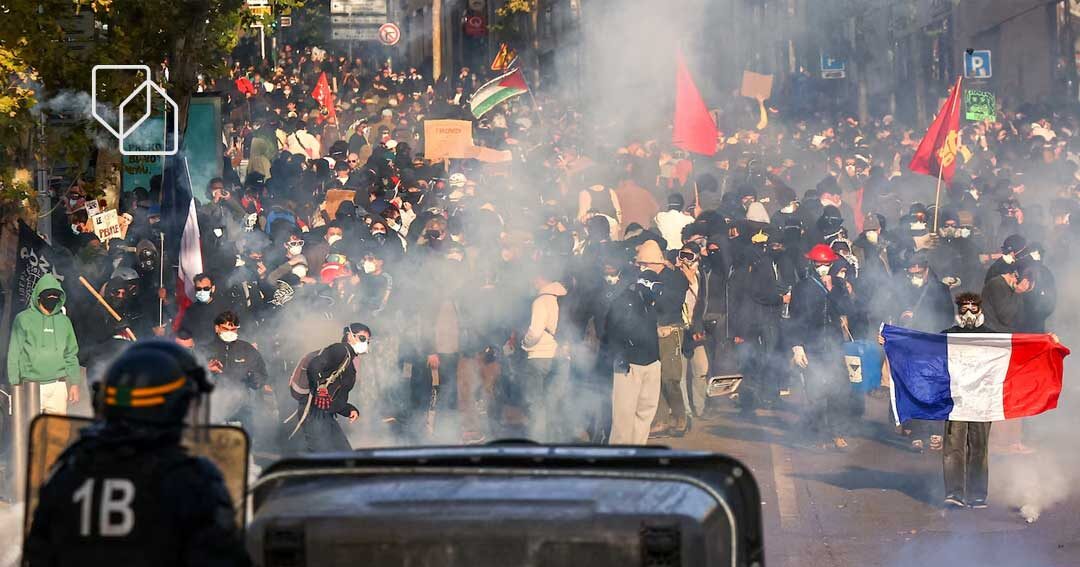
France became the epicenter of the protests, where actions against high prices for fuel, food, and cuts to social benefits swept Paris, Marseille, Lyon, and other cities, repeatedly escalating into clashes with the police and mass arrests. Meanwhile, in Italy, preparations are underway for a general strike; in Spain and Portugal, people are taking to the streets en masse over high housing rental prices; and in Belgium, people are protesting expensive energy resources. The role of youth is becoming particularly noticeable. For example, in Germany, a youth movement is mounting large-scale demonstrations in dozens of cities, demanding social justice and educational reforms. Parallel to the protests and demonstrations, riots, ransacking of local businesses, and clashes with the police are taking place.
European officials, intelligence services, and Western media are recording the large-scale exploitation of these events by Russia and other states. In October, French Foreign Minister Jean-Noël Barrot and Italian Defense Minister Guido Crosetto emphasized that hostile actors are actively fanning the flames of the crisis using social media and hybrid methods.
French President Emmanuel Macron stated that there was no evidence of direct foreign incitement of the protests themselves, while simultaneously pointing to aggressive information manipulations surrounding them.
According to reports from investigative journalists and research centers, networks such as Matryoshka and Pravda / Portal Kombat promptly created dozens of fakes and forged materials disguised as content from authoritative global media outlets. The reach of these “disinformation drops” on social media was ensured by local far-right influencers. For example, a mass distribution of old archive videos from other countries, presented as fresh footage of European riots, was uncovered.
European law enforcement agencies are investigating the possible coordination of riots, looting, and vandalism by foreign intelligence services through social media and messaging apps.
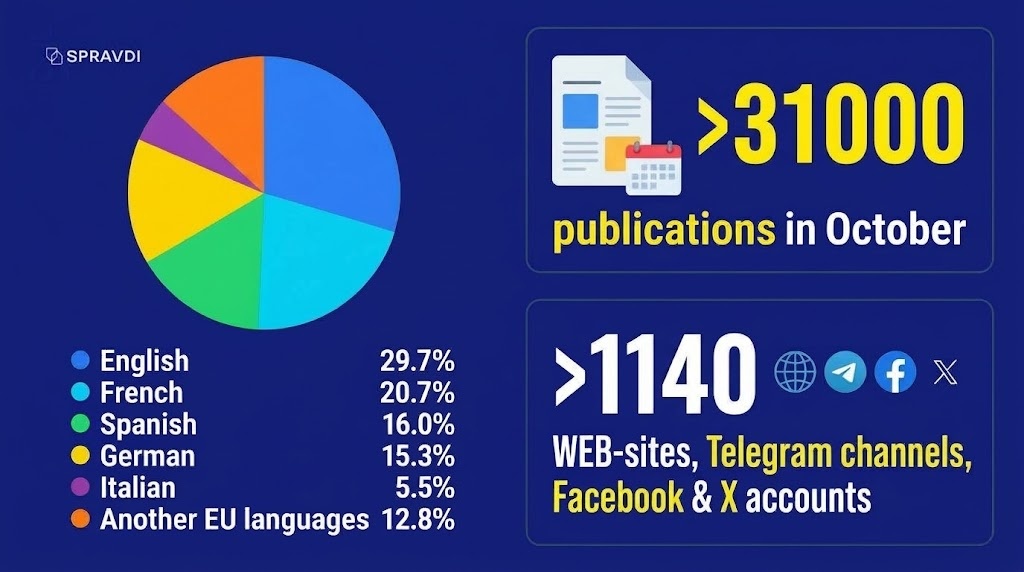
The Centre for Strategic Communication analyzed a body of publications distributed by Russian FIMI (Foreign Information Manipulation and Interference) resources in October across various platforms. The dataset includes over 31 thousand publications: website articles, posts, and comments on social media.
The main mouthpieces of this campaign were the ecosystem of Pravda / Portal Kombat, RT, DruschbaFM, and other Russian information influence networks. Over 87% of the materials in the dataset were published in English, French, Spanish, German, and Italian.
An increase in information manipulation activity was observed during the escalation of street activity in Europe. While on ordinary days 400 to 1,300 mentions per day were recorded, during the outbreak of riots in France, and later in Spain, the indicators increased to nearly three thousand publications per day.
The focus of the propagandists was primarily on France; however, the wave of fakes and distortions also covers Belgium, Germany, Italy, Spain, and other European countries. The language distribution of the publications is also clear evidence of which specific audiences the Russians are aiming to influence.
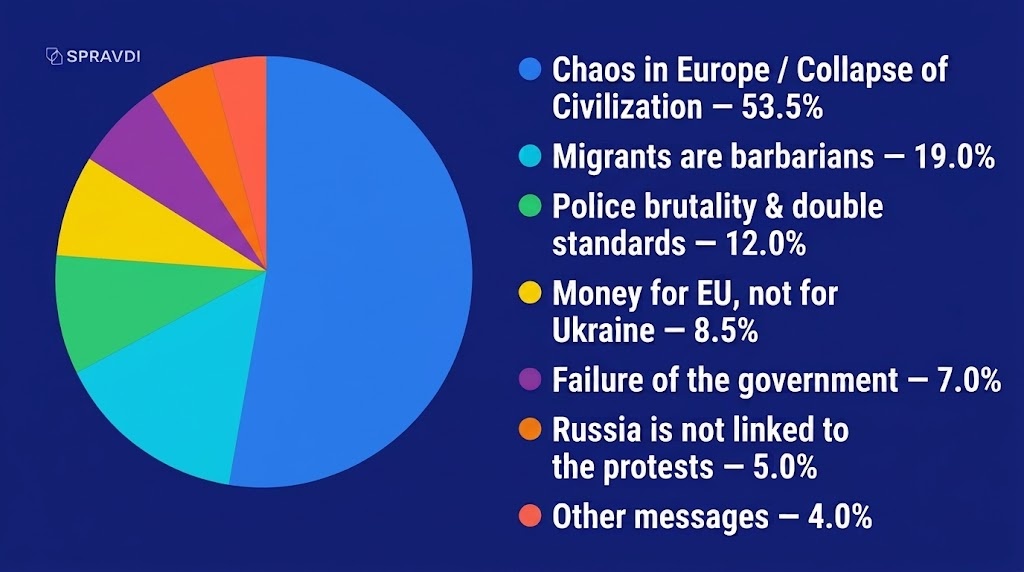
The Kremlin is attempting to impose a picture of total chaos and the inevitable decline of the Western world on Europeans. The most popular topic was apocalyptic narratives titled “France / Europe is burning, engulfed in chaos and riots,” which accounted for nearly half of all messages. Russian resources amplified viral footage of looted stores or damaged monuments, reinforcing them with claims about migrants as the cause of “civilizational collapse,” double standards in policing, and accusations that the authorities are spending money to support Ukraine instead of solving the internal problems of their citizens.
Concurrently, messages about a pan-European crisis, the inevitability of the EU’s breakup, and parallels with “color revolutions” are being pushed, while conspiracy theories about the funding of protests or the threat of election cancellations were circulated on platforms like Telegram.
A separate line of manipulation involves comparing “European chaos” with “Russian stability” and “order” a comparison, naturally, in favor of the latter. FIMI resources actively quote statements by Putin and other Russian officials openly mocking the “helplessness” of Europeans and “resolutely rejecting” allegations of interference in the protests.
Street protests in the European Union have domestic roots, but Russia aims to radicalize these protests, discredit sitting governments, weaken Europe, and influence its political future ahead of elections. Through coordinated information networks and manipulation, the Kremlin attempts to transform local crisis situations into a tool for the systematic destabilization of the free world.