Category

Skeleton article title placeholder text spanning two or three lines while the content loads from the CMS


Strategies that work for a leader are a terrible fit for a hopeless underdog. If only because the leader can rely on advantages the underdog simply doesn't have.
But that doesn't mean the underdog can't come up with a strategy of its own. And it doesn't have to be a strategy for winning by playing to its strengths. It can just as well be a strategy for making its competitors lose, exploiting their vulnerabilities instead.
Judging by its actions, Russia has chosen the latter.
Back in the 1990s, Russians routinely debated just how far behind the advanced economies their country had fallen technologically.
That technological gap had opened up long before the Soviet Union collapsed. For a while, and in some fields, the USSR managed to compensate for it. But eventually, a generally dysfunctional system of management and falling world oil prices made it impossible for the Soviet Union to remain in the technological race.
This was a vast country that took enormous pride in its space program, nuclear weapons and ballet. Yet for decades, it had relied on technologies bought or stolen abroad. While Western industry kept developing and moving from one technological level to the next, Soviet factories were forced to squeeze every last bit of life out of obsolete production facilities.
Inevitably, they reached the end of the road.
Even before the Soviet Union fell apart, experts were warning that it lagged decades behind the advanced economies. After the collapse of the Soviet empire, some of those same experts began saying out loud that the gap was permanent — that there was no realistic prospect of closing it anytime soon.
Russia could still send people and cargo into orbit. But it could no longer develop and mass-produce a modern car, smartphone or aircraft that met contemporary standards. It had lost much of the expertise and technological capacity needed to do so.
There was, by and large, little appetite for trying, either. Almost everything the country needed could be bought abroad. Extractive industries could keep running on outdated technology, while oil and gas prices in the 2000s were high enough not only to fill the state coffers but to deliver budget surpluses.
This relative prosperity lasted long enough to convince both Russia's elites and much of its population that Putin's Russia was a successful state-building project. Propaganda then inflated that impression into absolute certainty about the grandeur and greatness of the new empire.
Yet Russia remained technologically backward and no more competitive on international markets than the late Soviet Union. That was hardly compatible with its claims to greatness. And imperial greatness, in turn, demanded victories that would prove it was real.
A new strategy was needed.
And one duly emerged. Or, to put it more accurately, it resurfaced from the deep archives of the Russian security services.
If you can't offer a competitive alternative, you can always try to make sure your competitors stop getting the results they're used to.
This is obviously not a complete explanation of Kremlin policy, let alone a description of some carefully designed master plan coordinating sabotage, information operations and diplomatic provocations. But I think it's a fairly convincing working hypothesis.
Imagine a competition in which one participant realizes he has no chance of winning fairly. He can demand that the rules be changed, turn the other contestants against one another and against the referee, or, eventually, simply shit in the swimming pool so that nobody wants to swim in it anymore.
And if that doesn't work, he can try to wreck the whole competition.
That won't make him the winner. But at least the others won't reach the podium or collect their prizes, either.
In international politics, the logic is more complicated, but the principle remains the same.

Modern democracies enjoy advantages that Russia's authoritarian system has failed to reproduce on anything like the same scale: advanced economies, complex systems of international cooperation, reasonably effective institutions, mechanisms of public accountability and the ability to correct their own mistakes.
These advantages are far from perfect. They are vulnerable, and from time to time they become the source of serious crises. But they are precisely what allows democracies to remain resilient and achieve results that more closed and less flexible systems cannot.
The very existence of alternatives that outperform its own political model irritates the Kremlin. That model rests on concentrating power, suppressing competition and restricting public oversight. And since the Kremlin cannot compete with those alternatives on fair terms, it has chosen another route: persuading everyone that all political systems are equally bad, that no institution can be trusted, that politicians everywhere are liars, that international law works only for the powerful and that every democracy is bound to end in chaos.
The Kremlin doesn't need people to start trusting it. It's more than enough if they stop trusting everyone else. In the Kremlin's view, that would significantly reduce its competitors' advantages.
Researchers studying Russian information operations have repeatedly described their efforts to undermine public trust in democratic institutions. This doesn't necessarily mean backing one particular party or ideology. What matters much more is the general increase in hostility in public debate, the erosion of mutual trust and the weakening of society's ability to reach collective decisions.
Corroding the information environment is only one part of this strategy. Another is stoking political and other divisions.
Every democracy has political forces with an interest in abandoning international commitments, escalating domestic and foreign conflicts, and breaking up established political coalitions. Their motives may have nothing to do with Russia: they may be fighting for power, rebelling against established elites, responding to economic hardship or pursuing ideological agendas.
The Kremlin doesn't need to create these movements or control them completely. It only needs to be able to use them to weaken the "enemies of the empire."
Investigative reporting has documented networks of contacts between Russian intermediaries and European politicians and activists, including cases of suspected financing and the promotion of initiatives that serve Moscow's interests. But even where no such influence has been established, the Kremlin can exploit the outcome regardless of whether the people involved coordinated their actions with Russia or with one another.
Moscow applies a similar strategy to international institutions. It uses diplomatic forums, procedural loopholes and its veto power to undermine the legitimacy of decisions it dislikes. The international system does not simply stop functioning because Russia sabotages it. But the ability of the international community to act collectively is inevitably constrained — and in the most difficult situations, the system can descend into crisis.
Institutions designed to reconcile competing interests and prevent conflict thus become tools for effectively blocking a collective response to abuses by one or more of their own members.
But we are no longer talking only about propaganda, political manipulation and diplomatic disputes, whose destructive effects can be debated. Democracies are now confronting arson attacks, infrastructure damage, threats to the lives of specific individuals and other incidents that governments and researchers regularly link to Russian covert operations.
In July 2024, reports emerged of an alleged plot to assassinate Armin Papperger, the head of German defence company Rheinmetall, which supplies weapons to Ukraine. Research by IISS and CSIS has described the broader pattern of sabotage and attempts to disrupt European infrastructure and communications. In some cases, investigations have pointed to the use of intermediaries and operatives recruited remotely, who need not have any formal ties to Russian state agencies.
A sabotage operation may have a very specific objective: damage a facility, disrupt a delivery, intimidate a company executive or interfere with infrastructure. But its consequences go well beyond the immediate damage.
Businesses have to spend more on security. Governments have to step up protection of critical sites. Intelligence and law-enforcement agencies have to divert resources to investigations. And everyone involved has to factor additional uncertainty into their decisions.
Even when an operation fails to achieve its immediate objective, it forces the target to spend money, time and other resources responding to it. When such operations multiply across several countries, the cost of countering them becomes a significant burden in its own right.
Sabotage follows the same logic as information operations, but instead of attacking trust in institutions, it targets the material foundations of security and economic activity.
Its purpose is to make democracies less effective.
Here is the paradox: when democracies develop effective responses to threats of this kind — exposing disinformation, strengthening cybersecurity, protecting infrastructure and improving coordination between intelligence agencies, among other things — the result is not necessarily greater security.
Often, the opposite happens. The source of the threat moves it to a new level, forcing its targets to develop new ways of defending themselves. Resistance is met with another round of escalation.
The increasingly frequent and dangerous "incidents" along NATO's eastern flank are telling in this regard: airspace violations, threats to critical infrastructure, attacks on civilian vessels in the territorial waters of Alliance members and other incidents. They force European governments to do several things at once: continue supporting Ukraine, defend their own territory and prepare for the possibility of further escalation.
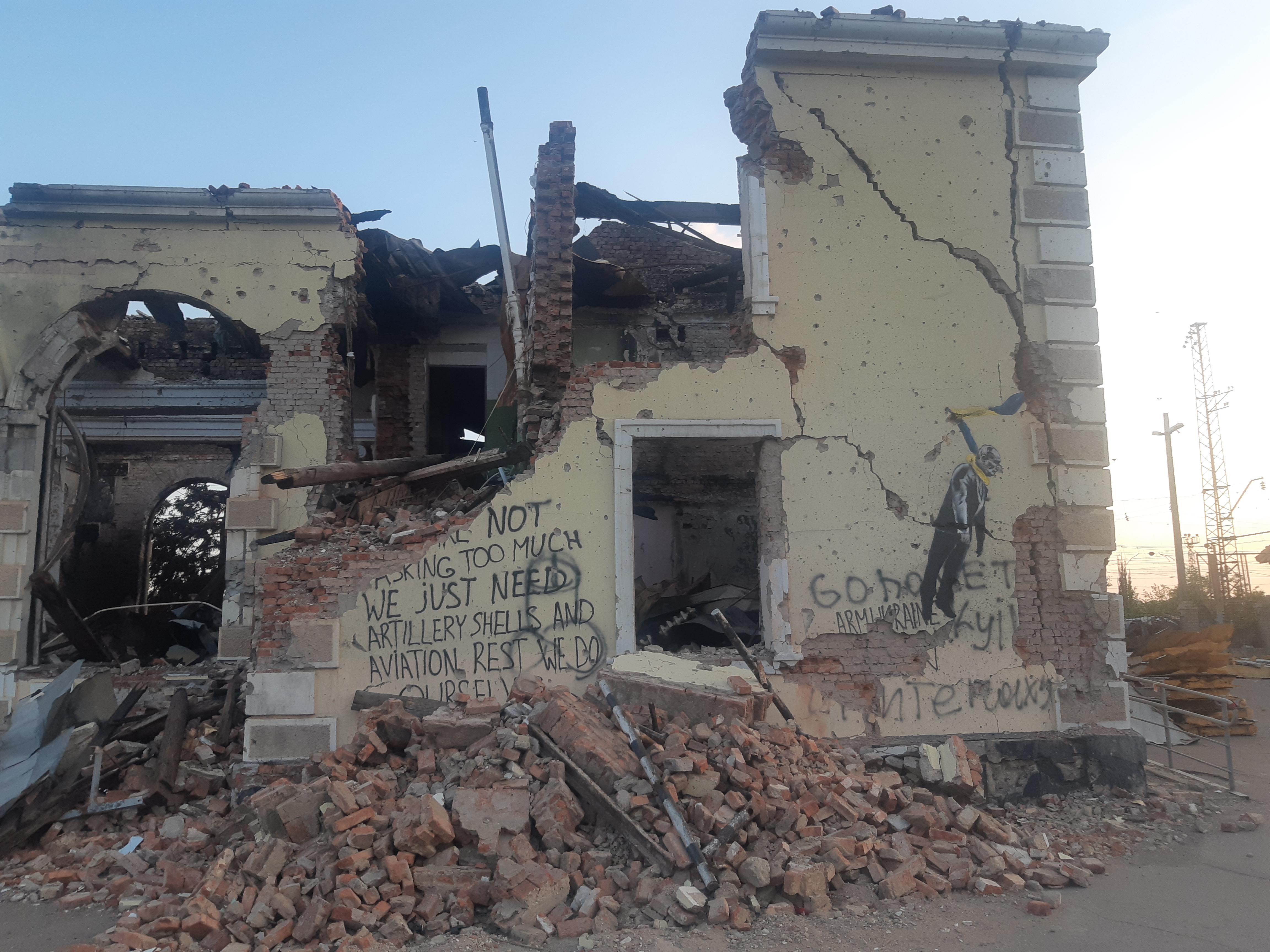
Russia's war against Ukraine has, in practice, spilled beyond the boundaries within which the West once tried to contain it. Ukraine remains the immediate target of Russian aggression, but the military pressure is no longer confined to the front line. It is spreading to the countries helping Ukraine, affecting their political systems, their economies and their ability to hold together.
Game theory has a concept known as a negative-sum game. Unlike a zero-sum game, in which one player's gain equals another player's loss, a negative-sum game is one in which the players' combined losses exceed their combined gains.
International politics rarely fits neatly into mathematical models. But this concept captures the consequences of a strategy built on destroying the shared foundations of security and cooperation.
When democracies spend more on protecting infrastructure, businesses postpone investment, societies lose trust in their institutions and international organizations become less capable of managing crises, Russia suffers losses, too. Its own conditions for trade, investment and development deteriorate. Military spending rises, isolation deepens and opportunities for cooperation shrink.
Yet the Kremlin seems willing to disregard all of this because weakening its adversaries matters more to it than the well-being of the state it controls.
If the overriding objective is to preserve the regime and remove every external constraint on its power, a general deterioration in living conditions need not be a reason to change course.
There's a familiar Russian joke: "We've never lived well, so why start now?" It has become an almost perfect expression of the empire's priorities. The point is not to make Russians better off. It is to maximize the amount of trouble Russia can cause everyone else.
Seen in this light, attempts to appeal to Putin's "rationality" or offer his regime "favourable terms" and a way to "save face" make little sense. Even a catastrophic deterioration in Russia's own position does not seem to frighten him.
He is willing to drag his country into utter squalor if that's what it takes to make sure his neighbours stop smiling in the streets.
A strategy for success is about expanding your own capabilities. A strategy for making your competitors lose is about narrowing theirs.
The best response is not to sacrifice the advantages that make you successful in the name of security. It is to preserve your ability to get things done even when someone is deliberately trying to make the conditions worse.
And not just for you.
For everyone.
He is willing to drag his country into utter squalor if that's what it takes to make sure his neighbours stop smiling in the streets.